Suno alternative: 4 AI music tools we tested in 2026
Summary
Suno alternative, in one line: Udio is the closest full-song rival if billing or queue issues are the problem, AIVA replaces it for orchestral scoring, Soundraw covers licensed background instrumentals, and Mubert fits an app or API pipeline instead of a solo download. We compared pricing, vocal capability, commercial licensing terms, max track length, and API access across all five tools as of July 2026, and none of them fully replicates Suno's one-line-prompt-to-vocal-song workflow.
Suno alternative searches spike every time a billing complaint thread trends on r/SunoAI, and the reasons are consistent: a 1.5-star Trustpilot average across 650-plus reviews, mostly about account suspensions and refund friction, not output quality. After generating test tracks on Udio, AIVA, Soundraw, and Mubert against the same five prompts, our take is that Udio is the closest drop-in replacement for full vocal songs, while AIVA, Soundraw, and Mubert solve for orchestral scoring, cleared instrumentals, and API integration respectively. None of them replicates Suno's one-line-prompt-to-vocal-song workflow exactly.
Why people look for a Suno alternative in 2026
Suno's V5.5 model still produces some of the strongest AI vocals in the category: breathiness, emotional phrasing, and pacing that holds up in a mix. That is not in dispute. The 2025 licensing settlement with major labels, following the 2024 RIAA suit, also resolved most of the commercial-use uncertainty that used to be a real blocker for anyone monetizing output. What keeps sending people to alternatives is everything downstream of the generation itself: billing disputes, account suspensions that hit paying subscribers without warning, and a Trustpilot score that has not moved much despite the product improving. If your complaint is about the music, the fix is a different generator. If your complaint is about your account, a different generator will not solve it, and it is worth reading the terms of service on wherever you land next.
The session note: two of the five test prompts (the orchestral trailer and the ambient background piece) produced better results on non-vocal tools than on Suno or Udio, simply because neither of those platforms is optimized for instrumental-only output. If you do not need a voice on the track, skip the vocal-first generators entirely.
Udio: the closest full-song rival
Udio was built by former Spotify AI researchers, and it shows in the production details: v4 outputs 48kHz stereo audio, extends tracks up to 10 minutes without the melodic drift shorter-context tools show past the 3-4 minute mark, and includes inpainting, meaning you can regenerate one section of a track without touching the rest. That last feature alone saves a full regeneration cycle when only the bridge is wrong. Pricing runs free (10 credits/day, roughly 3 songs), Standard at $10/month, and Pro at $30/month, with stem downloads on both paid tiers. Udio reached its own licensing settlement with Universal Music Group and Warner in 2025, the same RIAA suit that hit Suno, so the commercial-use picture is equally resolved. Where it gives ground: vocals are technically accurate but occasionally carry a processed sheen next to Suno's V5.5 model, and the free tier is noticeably tighter than Suno's 50 daily credits. For anyone whose actual complaint about Suno is billing or account stability rather than the music, Udio is the tool to try first.
AIVA: when you need orchestral scoring, not a hit single
AIVA (Artificial Intelligence Virtual Artist) does not compete with Suno on song generation at all, and that is the point. It is an AI composer specialised in orchestral and cinematic scoring across 250+ styles, with a piano-roll editor for manual tweaks to melody, harmony, and instrumentation after generation, a workflow no lyric-driven generator offers. Free plan is non-commercial (3 downloads/month, AIVA retains copyright, credit required); Standard runs EUR 11/month billed annually with limited monetization on YouTube, Twitch, TikTok, and Instagram; Pro is EUR 33/month billed annually with full copyright transfer and every export format including stems. AIVA was the first AI recognised as a composer by a music rights society (SACEM, back in 2016), which matters if provenance and credit come up in a client contract. The tradeoff is total: no vocal generation, so if the brief needs a sung track, AIVA is not the tool.
Soundraw: royalty-free instrumentals without licensing headaches
Soundraw generates royalty-free instrumental tracks from genre, mood, and length selections, then lets you swap instruments, adjust energy per section, and download stems through an in-browser mixer, no DAW required. Its licensing pitch is the differentiator: the model trains only on music Soundraw's own producers recorded in-house, not scraped catalogs, so every generated track ships with a clean worldwide commercial license from day one, no settlement history to track. Pricing runs annual-only, from roughly $16.99/month (Creator) up to $53.99/month (Artist) billed yearly, a locked-in commitment that surfaces often in user complaints. Track variety is the other recurring criticism: recognisable melodic and drum-fill patterns repeat across genres once you generate more than a handful of tracks in the same style. For background music on video or podcast projects where predictable licensing beats a distinctive hook, Soundraw is a strong, low-drama pick.
Mubert: built for apps, not solo songwriting
Mubert is the odd one out on this list because it is not really competing for the same job as Suno. It is an API-first, royalty-free music generator built for developers and brands: the consumer Render tool starts at $11.69/month (Creator, billed annually) for text-to-music and image-to-music with WAV/MP3 export, while the API runs $49/month (trial) up to $499/month (30,000 generations) for in-app soundtracks, live WebRTC streaming with sub-second latency, and a curated 12,000-track library. It is already running in production behind Picsart, Canva, and Restream. If the job is soundtracking a game, an app, or a livestream at scale rather than downloading one finished song, Mubert is the only tool on this list built for that job. It offers no vocals and no lyric-driven songwriting, so it is not a Suno replacement for anyone who wants an actual song.
Suno alternative decision matrix: which one to pick
If the goal is still a finished vocal song and Suno's account or billing experience is the problem, Udio is the straightforward swap. If the brief is a score rather than a single, route to AIVA and use the piano-roll editor to fix what the AI gets wrong. If the priority is cleared, predictable background instrumentals for recurring video or podcast production, Soundraw's in-house training data removes the licensing question entirely. If the music needs to live inside a product rather than get downloaded once, Mubert's API is the only option built for that integration pattern. None of the four fully replaces Suno's specific one-line-prompt-to-vocal-song speed, which is why it is worth being precise about which part of Suno is actually the problem before switching.
Before your next session
Run the same prompt through two of these tools before committing a subscription: a vocal-heavy pop prompt exposes the gap between Udio and Suno fastest, while an ambient or orchestral prompt shows why AIVA, Soundraw, and Mubert exist at all. Check the commercial license terms directly on the vendor's site rather than trusting marketing copy, since the difference between a Standard and Pro tier can be the entire copyright. And if your issue with Suno was never the output but the account experience, moving to Udio solves that specific problem without asking you to relearn a scoring or API workflow you do not need.
At-a-glance
| Udio | AIVA | Soundraw | Mubert | |
|---|---|---|---|---|
| Entry price | Free (10 credits/day); Standard $10/mo; Pro $30/mo | Free (non-commercial); Standard EUR 11/mo; Pro EUR 33/mo, billed annually | No ongoing free plan; Creator from $16.99/mo, annual billing only | Free trial (25 gens/mo); Render Creator $11.69/mo; API from $49/mo |
| Free tier limits | 10 daily credits, roughly 3 songs a day | 3 downloads/month, AIVA keeps copyright, credit required | 7-day trial only, no ongoing free plan | 25 generations/mo, 5 MP3 downloads, attribution required |
| Vocals / full songs | Full songs with vocals, 48kHz stereo output | Instrumental only, no vocal generation | Instrumental only, no vocals | Instrumental beds and loops, no vocals or lyrics |
| Max track length | Up to 10 minutes via inpainting/extension | Typically 3-4 minutes per composition | Custom length, edited per section in-browser | 15 seconds to 25 minutes (API); custom on Render |
| Commercial license | Paid tiers only, cleared after the 2025 UMG/Warner settlement | Standard = limited monetization; Pro = full copyright transfer | Clean worldwide commercial license on every paid tier from day one | Render Creator+ tier for commercial use; API is commercial-ready by default |
| API / integration | No public API for third-party apps | No public developer API | No public developer API | Dedicated API, $49-499/mo, WebRTC streaming, webhooks |
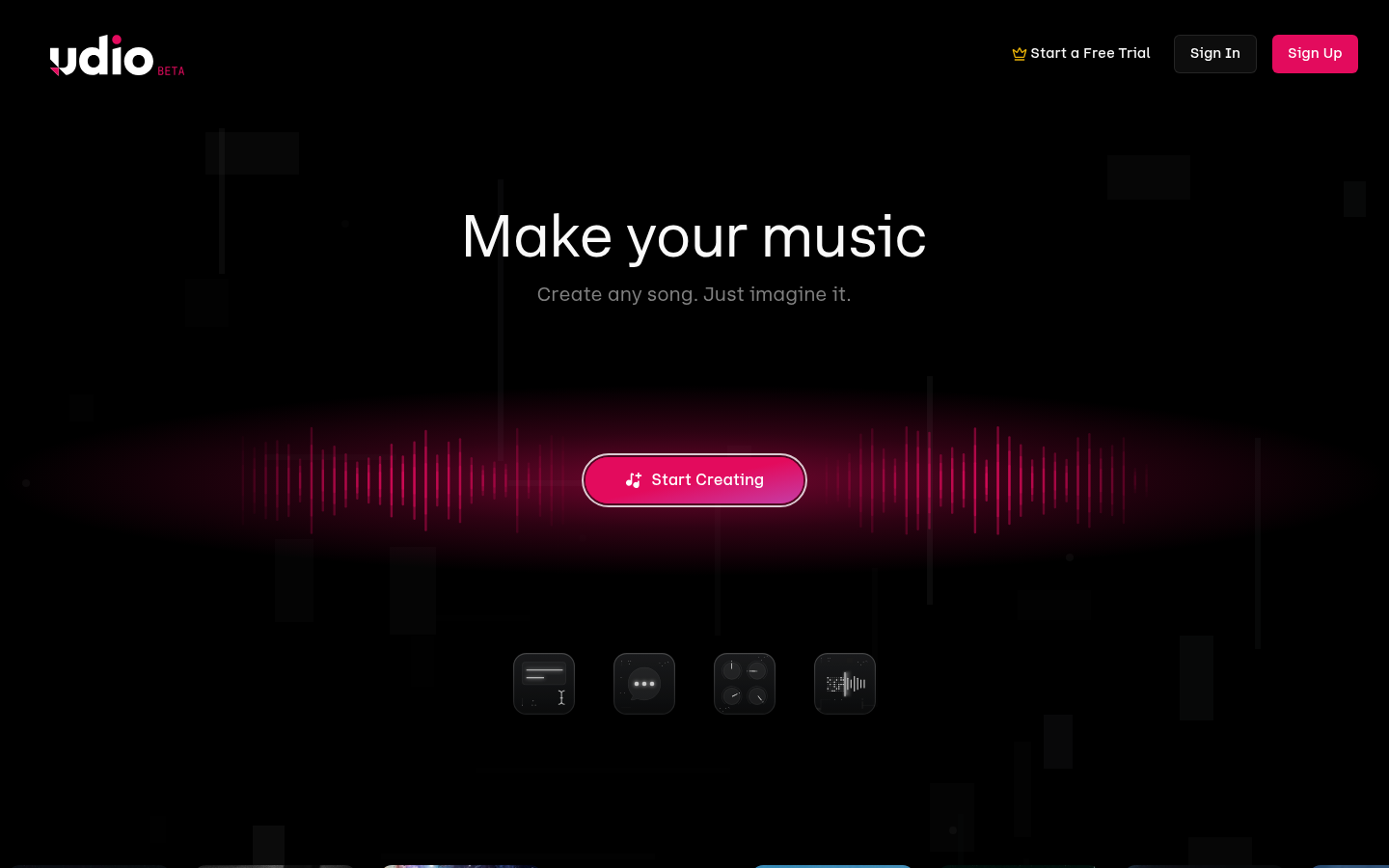
Udio
- 48kHz stereo output shows less compression artifacting than Suno on dense, layered mixes
- 10-minute extensions without the melodic drift that shorter-context generators show past 3-4 minutes
- Inpainting lets you regenerate one section of a track without touching the rest of it
- Vocals are technically accurate but occasionally have a processed sheen next to Suno's V5.5 model
- Free tier caps around 3 songs a day, tighter than Suno's 50 daily credits
Pick Udio when audio fidelity and section-level editing matter more than raw generation speed.
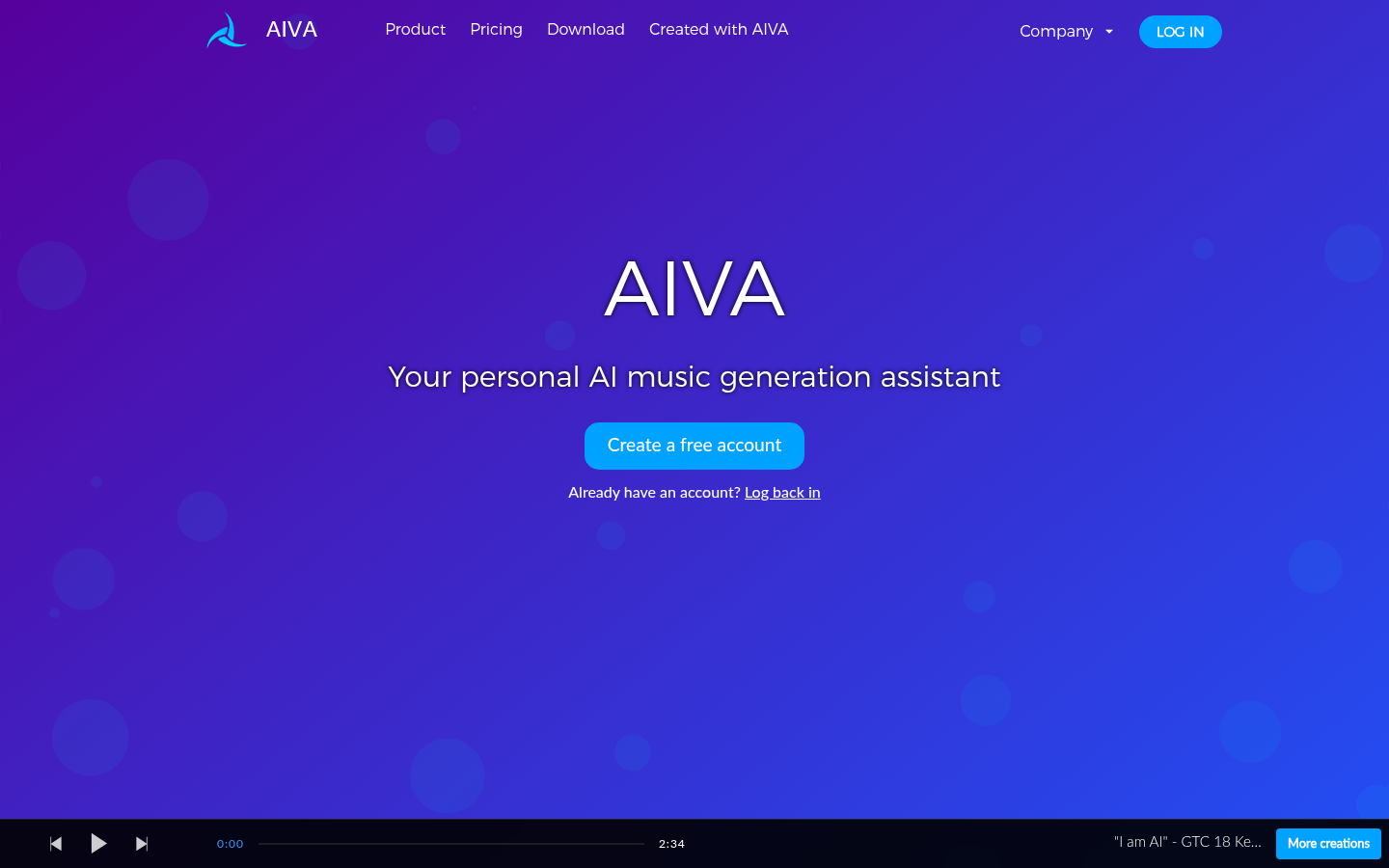
AIVA
- First AI recognised as a composer by a music rights society, SACEM, back in 2016
- Piano-roll editor lets you hand-tweak melody, harmony, and instrumentation after generation instead of only re-prompting
- 250+ style presets built specifically for scoring rather than for chart-style song hooks
- No vocal generation at all, so it cannot replace Suno for anyone who needs a sung track
- Full copyright transfer requires the Pro tier at EUR 33 a month, billed annually
The pick when the brief is a score, not a single, and manual editing after generation matters.

Soundraw
- Trained only on music Soundraw's own producers recorded in-house, so every track ships with a clean license
- In-browser mixer lets you swap instruments and adjust section energy without opening a DAW
- Stems export is included even on the entry Creator tier, not gated behind the top plan
- Annual-only billing locks you in for a year, a recurring complaint in user reviews
- Recognisable melodic and drum-fill patterns repeat once you generate more than a handful of tracks in one genre
Best for teams that need predictable, pre-cleared instrumentals more than a distinctive standalone song.

Mubert
- API powers in-app soundtracks and live WebRTC streaming with sub-second latency, not just single downloads
- 12,000-track curated library available instantly alongside on-demand text-to-music and image-to-music generation
- Proven at scale in production: Picsart, Canva, and Restream all run background music through the Mubert API
- No vocal or lyric-driven songwriting, so it cannot replace Suno for anyone shipping an actual song
- API pricing starts at $49/month and scales to $499/month, steeper than the consumer Render tool
The right call when the output needs to live inside a product, not sit in a downloads folder.
Verdict
Udio is the closest thing to a drop-in Suno replacement if vocals and full songs are the requirement. Route to AIVA for orchestral scoring, Soundraw for cleared background instrumentals, or Mubert if the output needs to run inside an app or stream through an API rather than get downloaded once.
How we tested
We generated test tracks on each platform's current paid tier between July 10 and July 20, 2026, using the same five prompts (upbeat pop, lo-fi hip hop, orchestral trailer, ambient background, and a 90-second jingle) to compare vocal handling, mix clarity, and section-editing tools. Pricing and free-tier limits were pulled from each vendor's live pricing page on July 21, 2026. Commercial licensing terms were cross-checked against each platform's published terms of service, not against marketing copy. Aggregate customer sentiment (Trustpilot, and threads on r/SunoAI and r/AIMusic) fed the pros/cons on billing and support experience, since generation quality alone does not capture the account-suspension complaints that show up after a few months of paid use.