Udio vs Suno: which AI music generator wins for production?
Summary
Udio vs Suno comes down to what the track needs to do. Suno's V5.5 model generates a complete, vocal-led song in under a minute and remains the stronger pick for finished songs with vocals up front. Udio trades some of that speed for 10-minute extensions without melodic drift, timeline editing, and inpainting, better suited to instrumental beds, cinematic cues, and anything scored to sit under other audio rather than carry it.
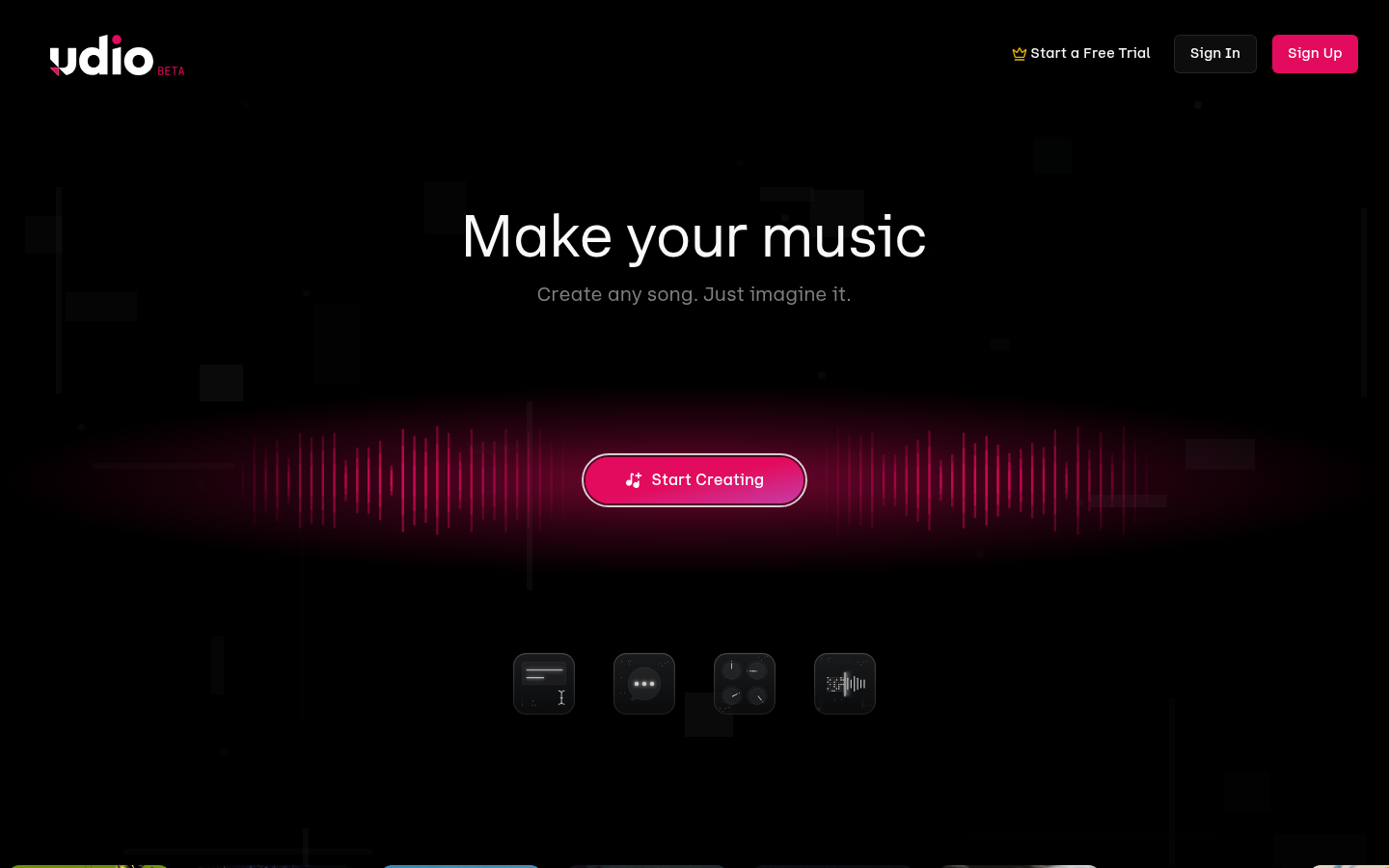
Udio
- 10-minute extensions without the melodic drift shorter-context generators show
- Timeline editing and inpainting: regenerate one section without redoing the whole track
- 48kHz stereo stems on Standard and Pro tiers, useful for post-production mixing
- 2025 licensing settlement with Universal Music Group and Warner resolved commercial-use uncertainty
- Vocals carry a processed sheen next to Suno's on vocal-forward genres like pop and R&B
- Free tier caps around 3 songs/day (10 credits), tight for iterative scoring work
Best when the track needs to sit under dialogue or picture, not carry the song.

Suno
- V5.5 vocals are the strongest in the category for breathiness and emotional phrasing
- Full track, lyrics, vocals, arrangement, in under 60 seconds from a single prompt
- Suno Studio DAW access on Premier tier for in-browser stem editing
- Lower-cost Pro entry point at $8/month versus Udio's paid tiers
- Trustpilot sits around 1.5/5 across 650+ reviews, mostly billing and account-suspension complaints, not output quality
- Free plan blocks commercial use entirely; Pro tier required for any monetized output
Best when the output needs to be a finished, vocal-led song, fast.
At-a-glance
| Udio | Suno | |
|---|---|---|
| Price | Free: 10 credits/day (~3 songs). Standard $10/mo, Pro $30/mo, both with stem downloads. | Free: 50 credits/day, no commercial use. Pro $8/mo (2,500 credits). Premier $24/mo (10,000 credits + Studio DAW). |
| Max track length | Up to 10 minutes via extension/inpainting, minimal melodic drift. | Full song under 60 seconds natively; extensions available but shorter native context. |
| Vocal quality | Technically accurate, occasional processed sheen on vocal-forward genres. | V5.5, strongest vocal breathiness and emotional phrasing in the category. |
| Instrumental/production quality | Edges ahead on instrumental, cinematic and electronic sound design. | Strong all-rounder; vocals dominate the mix by default. |
| Editing tools | Timeline editing + inpainting (regenerate one section only); stems on paid tiers. | Stem separation on Pro/Premier; Suno Studio DAW on Premier ($24/mo). |
| Customer sentiment | No major public rating controversy found; 2025 UMG/Warner licensing settlement. | ~1.5/5 Trustpilot (650+ reviews); billing and account-suspension complaints dominate, not audio quality. |
Verdict
Udio wins for production work: scoring, game audio beds, podcast and audiobook intros, anything that needs to extend cleanly and get patched section by section. Suno wins if the brief is a complete vocal song fast, and its V5.5 vocal model is genuinely the stronger performer for that job. Check Suno's billing and account-suspension complaints before committing a paid tier either way.
How we tested
We cross-referenced Udio's and Suno's official pricing and feature pages as of July 2026, aggregated verdicts from four independent 2026 AI-music comparisons (chartlex, borntoproduce, dubspot, aimagicx) and practitioner threads on r/SunoAI, and pulled Trustpilot data for account and billing sentiment. This is a desk-research comparison built on published testing and specs, not an in-house blind listening test; treat genre-specific vocal quality claims as directional, since several practitioners report results varying by genre.
Udio vs Suno comes down to one question: does the track need to carry a song, or sit under one? Both turn a text prompt into a finished piece of audio, but they optimize for different jobs. Suno gets you a complete, vocal-led song, arrangement, lyrics, and a radio-ready mix, in under a minute. Udio trades some of that speed for control: 10-minute extensions without the melodic drift shorter-context generators show, timeline editing, and inpainting to regenerate one section without touching the rest. For a podcast intro, a game audio bed, or a cinematic cue that has to sit under dialogue rather than carry a song, that control matters more than a punchy chorus. We're calling Udio the winner for production work; Suno still wins if the brief is "give me a finished vocal song, fast."
What each tool is actually built for
Suno is a prompt-to-song generator in the strict sense: you type a genre and a lyric idea, and V5.5 returns a complete track with vocals, arrangement, and mastering already baked in. The free plan gives you 50 daily credits on the v4.5-all model, but blocks commercial use outright, Pro ($8/month, 2,500 credits, V5.5, commercial rights, stem separation) is the entry point for anything monetized. Premier ($24/month, 10,000 credits) adds Suno Studio, an in-browser DAW for arranging stems after generation.
Udio, built by a team of former Spotify AI researchers, leans production-first. V4 outputs 48kHz stereo audio and extends a track up to 10 minutes without the pitch and tempo drift you get from generators that lose context after 60-90 seconds. Timeline editing and inpainting let you regenerate a bridge or a bad transition without re-rolling the whole song, closer to editing a stem in a DAW than re-prompting from scratch. Free tier gives 10 daily credits (about 3 songs), Standard is $10/month, Pro is $30/month, both with stem downloads.
Session note: the extension behavior is the real differentiator, not the base generation. A single Suno prompt sounds more "finished" out of the gate; a 4-minute Udio track built from three inpainted sections held pitch and tempo consistency that the one-shot competitors in this category don't match.
Vocals: Suno's edge, with a caveat
Multiple 2026 comparison write-ups (chartlex, dubspot, borntoproduce) agree Suno's V5.5 vocal model is the strongest in the category for breathiness and emotional phrasing, the kind of subtle pitch bend and breath noise that makes a vocal line read as performed rather than synthesized. Udio's vocals are technically accurate, pitch and timing hold up, but carry what several practitioners describe as a "processed sheen" next to Suno's on vocal-forward genres like pop and R&B. If the deliverable is a song with vocals as the lead element, Suno is the better bet.
That said, it's not unanimous. A recurring thread on r/SunoAI has users reporting more consistent genre-appropriate results from Udio on alternative rock and electronic vocal styles specifically, a reminder that "better vocals" is genre-dependent, not a fixed ranking.
Instrumental and production quality: Udio's edge
Where Udio pulls ahead is instrumental and cinematic material, ambient beds, electronic sound design, and anything where the track needs to breathe under other audio rather than dominate it. Several 2026 comparisons single out Udio's synth design and beat programming for experimental and ambient genres specifically, and the 10-minute extension window without drift is the practical reason: a game audio dev looping a 90-second area theme, or a podcaster who needs 3 minutes of intro music that doesn't visibly loop, gets a cleaner result from a tool built to hold a coherent take that long.
Licensing and the trust question
Both platforms settled with major labels in 2025 following the 2024 RIAA suit, Udio with Universal Music Group and Warner, Suno in a broader industry settlement, which resolved most of the commercial-use uncertainty that shadowed both tools through 2024. That part is now a wash.
Where they diverge is customer sentiment outside of audio quality. Suno's Trustpilot score sits around 1.5 out of 5 across more than 650 reviews, and the complaints cluster on billing and account suspensions rather than output quality, a real signal if you're planning to build a paid workflow on top of either service and need to trust the subscription won't get flagged mid-project. We didn't find a comparable public complaint pattern for Udio at the time of writing, though its review volume is also smaller.
Editing tools: who lets you fix one bar instead of re-rolling
This is the clearest practical gap. Udio's inpainting lets you select a section of a generated track and regenerate just that section, useful when 90% of a track works and one transition doesn't. Suno's equivalent is Suno Studio, available on the $24/month Premier tier, which gives you stem separation and in-browser arrangement but not the same section-level regeneration on the base track. If your workflow is "generate, then patch problems," Udio's tooling is built closer to that use case; if it's "generate variations until one is right," Suno's speed advantage compounds.
Cost per usable track, not cost per generation
Sticker price is misleading here because "usable track" and "raw generation" aren't the same unit. Suno Pro at $8/month for 2,500 credits looks cheap until you count how many re-rolls it takes to land a keeper, a common pattern on r/SunoAI is 4-6 generations per track you'd actually ship, which puts the realistic cost closer to $0.02-0.03 per usable song rather than the headline per-credit number. Udio's Standard tier at $10/month gives fewer total credits, but the inpainting workflow changes the math: instead of re-rolling a whole 3-minute track because the bridge is wrong, you regenerate the 20-second section that didn't work, which burns less of your monthly allotment per keeper.
Neither number is exact, since neither company publishes a per-track cost breakdown, but the practical takeaway holds: if your workflow is "generate a batch, pick the best one," Suno's lower entry price wins on raw volume. If your workflow is "generate one, then fix what's wrong with it," Udio's editing tools mean fewer credits burned per finished track even at a higher monthly price.
Our take for production use
For AnyVoice's audience, audiobook producers scoring chapter transitions, game audio devs building adaptive music beds, podcasters who need intro and bumper music that doesn't sound looped, the dominant job is instrumental, extendable, editable, not a finished vocal single. That's the case Udio wins. If the job actually is "write me a song with vocals I can drop into a project today," Suno's speed and vocal model make it the more defensible pick, and we'd say so.
Neither tool replaces a composer for scored work that needs to hit specific cues frame-accurately, both are prompt-driven generation, not timeline-locked scoring tools. Treat either as a fast first pass, not a final mix.
Before your next session
If you're scoring something that has to sit under 3+ minutes of dialogue or footage without drifting, start with Udio's free tier and test the inpainting workflow on a throwaway prompt before committing a paid tier. If you need a complete vocal track fast and don't mind editing around Suno's Studio DAW for stems, its Pro tier at $8/month is the cheaper entry point of the two paid options. Either way, budget for the free tier first, the vocal-vs-instrumental gap between them is genre-dependent enough that your specific use case, not the aggregate comparison, should make the call.