What is AI noise cancellation and how it actually works
Summary
AI noise cancellation uses deep neural networks trained on paired clean and noisy audio to remove background noise in real time. It achieves up to 40dB suppression on non-stationary noise, versus 15dB for traditional spectral methods. The pipeline: frequency decomposition, speech identification, noise estimation, gain reduction, and reconstruction. On-device inference runs at 10-50ms latency. The most practical tool for cleaning voice recordings before they enter a synthesis or voice-cloning pipeline.
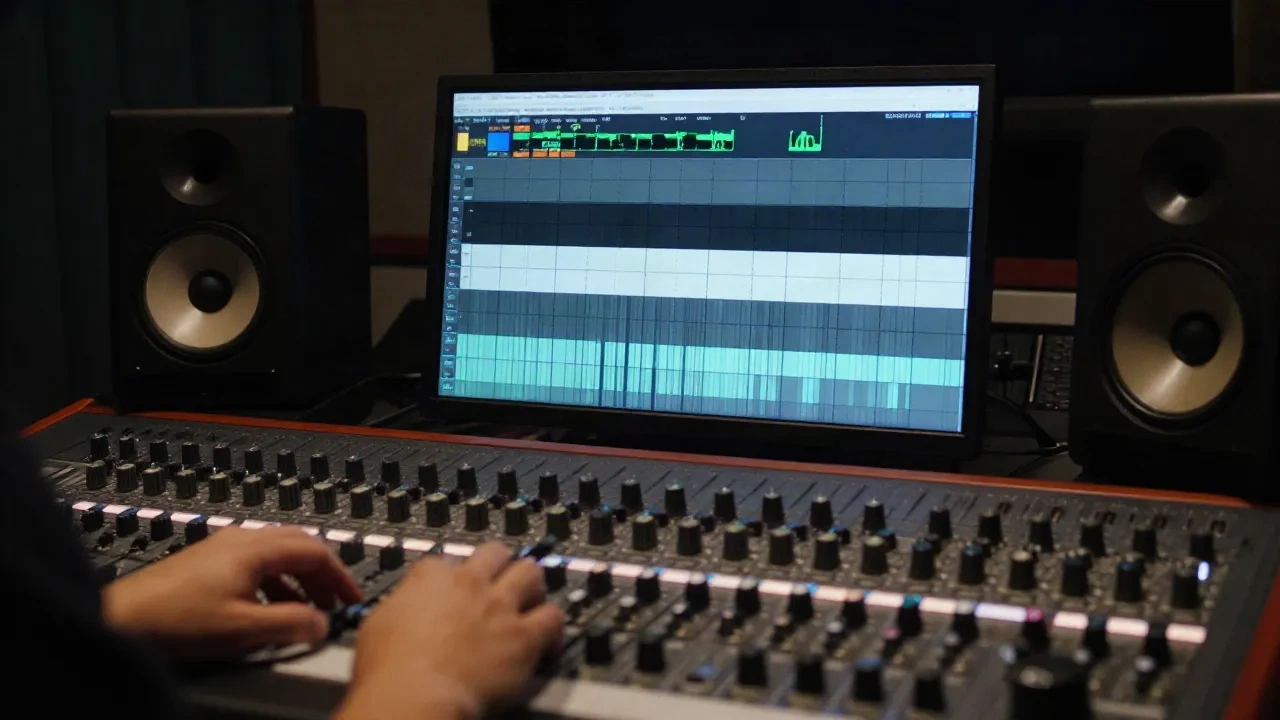
AI noise cancellation is a signal-processing technique powered by deep neural networks that removes background noise from audio by reconstructing a clean version of the signal, not simply subtracting frequencies. A trained model analyzes your microphone input frame by frame, separates speech from ambient noise, and outputs only the isolated voice. That is what is AI noise cancellation in practical terms: up to 40dB of suppression on dynamic noise sources, with latency as low as 10ms on-device.
Why "cancellation" is a misleading term for what AI actually does
Traditional noise cancellation, the kind found in headphones using active noise control, works by generating an inverted copy of an incoming sound wave and combining the two to cancel amplitude. It is a physical, analog process that performs best against steady, predictable low-frequency noise: airplane cabin hum, HVAC drone, road rumble.
The AI variant works on a completely different principle. There is no inverted wave. A deep neural network, trained on thousands of hours of paired clean-speech and noisy-speech recordings, has learned to recognize what speech looks like in the frequency domain and what it does not look like. Given a noisy audio frame, the model estimates the probability that each frequency component belongs to speech, then constructs a clean output from that estimate.
The distinction matters for practitioners: traditional active noise control does not touch your microphone signal at all, it acts on what your ears receive. AI noise cancellation acts directly on the microphone signal before it reaches your DAW, your streaming encoder, or your voice-cloning pipeline.
The five-stage pipeline inside a deep learning noise model
Most production-grade AI noise suppression systems operate on a recognizable pipeline:
Frequency decomposition - the input audio is converted to a frequency-domain representation, typically via a short-time Fourier transform (STFT) or a learned filterbank.
Speech and noise identification - a neural network (usually RNN or CNN-based) analyzes the spectral frame and classifies components as voice or non-voice.
Noise estimation - the model estimates the noise floor, including non-stationary components that are changing over time.
Gain reduction - a spectral mask is applied, attenuating noise-classified components while preserving speech-classified ones.
Audio reconstruction - the modified spectral representation is converted back to a time-domain waveform via an inverse transform.
The key performance difference comes from step 2. Traditional Wiener filtering uses hand-crafted statistical models to estimate the signal-to-noise ratio. A deep neural network discovers non-linear mappings from training data and handles noise profiles that were never explicitly modeled. That is why the suppression number is different: traditional methods reach roughly 15dB of steady-state reduction; DNN-based systems achieve between 21dB and 40dB on dynamic noise, depending on the model and the noise type.
Where traditional noise gates and spectral subtraction fall short
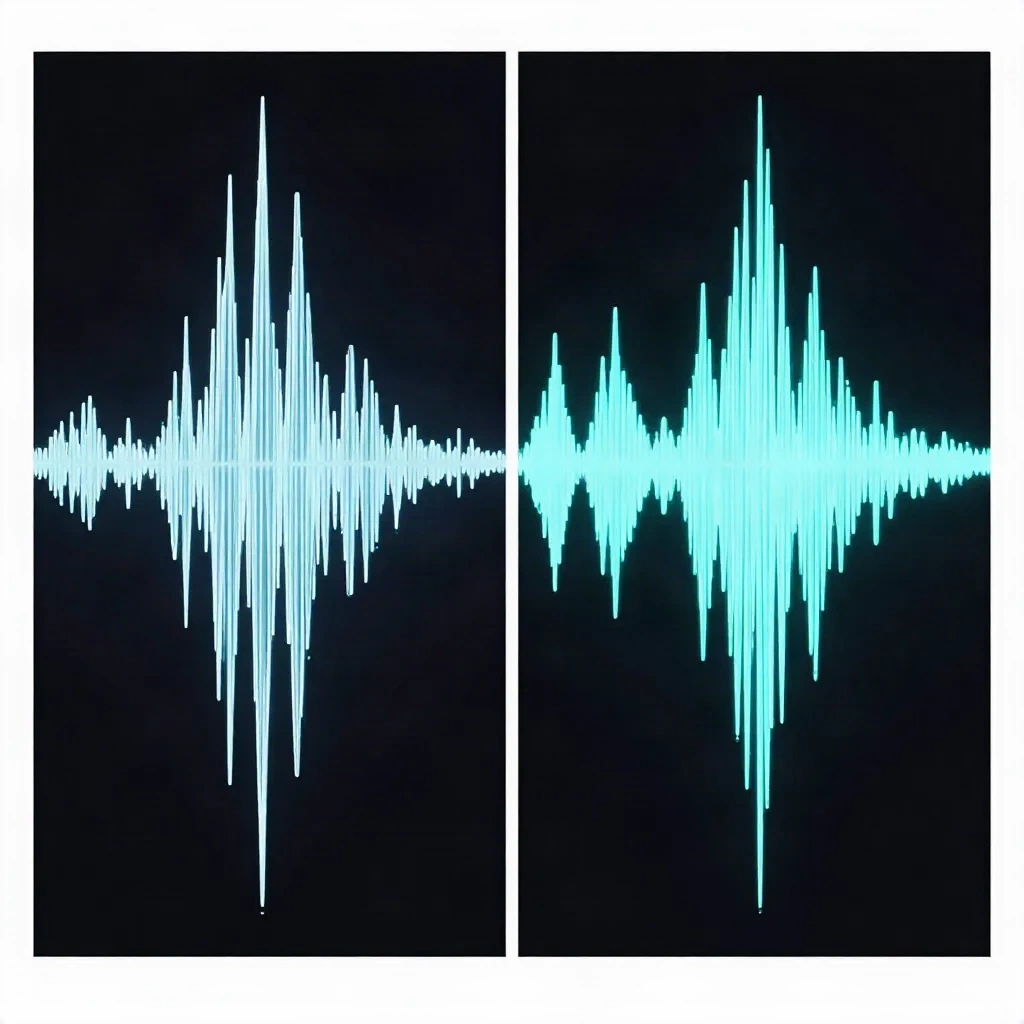
Noise gates are the most common noise-management tool in recording environments. A gate closes the signal path below a set threshold, which works well when the speaker is silent: the background noise disappears. When the speaker opens their mouth, the gate opens and the background noise comes back in.
There is no workaround for this. A gate cannot distinguish "keyboard clatter while you are talking" from "your voice." Both happen simultaneously, both exceed the threshold, and both pass through.
Spectral subtraction, an older software technique, improves on this by targeting specific frequency bands. It measures the noise floor during silence, then subtracts that estimated spectrum from the active signal. The limitation is that it models the noise as stationary, meaning it assumes the noise profile does not change significantly over time. Real-world noise is rarely stationary: HVAC clicks on and off, a delivery van passes, a colleague starts a phone call in the background.
When a spectral subtractor encounters non-stationary noise, it produces a characteristic artifact: a wavering tonal residue in the output, sometimes called "musical noise." It is identifiable to any experienced listener and adds a processing sheen that is difficult to remove in post.
Session note: if you hear a metallic shimmer on a voiceover track that has already had noise reduction applied, it is almost certainly a spectral subtraction artifact from an older plugin or conferencing tool. You will not hear this on the output of a well-implemented DNN-based system.
Non-stationary noise: the production bottleneck AI actually solves
This is the practical reason why audio engineers running voice-cloning or voice-recording workflows have started using AI noise cancellation at the capture stage, not just in post.
Consider a typical scenario: a narrator recording at home has a consistent room tone that any competent noise reduction plugin can handle. But the session also includes a passing ambulance at minute 14, a refrigerator compressor cycling at irregular intervals, and the click of a mouse during breath pauses. A traditional spectral subtractor, calibrated on the room tone, will leave those transient intrusions mostly intact. A trained DNN model will suppress all three, because it has seen ambulances, refrigerators, and mouse clicks in its training data.
For voice-cloning workflows specifically, this matters more than in standard narration. The quality of a cloned voice depends heavily on the cleanliness of the source sample. Periodic noise intrusions in the sample audio can introduce tonal inconsistencies in the clone's output, particularly around formant transitions. Giving the neural voice-cloning model a cleaner input reduces those artifacts at the source rather than requiring post-processing on every generated line.
Latency, edge processing, and the live-session trade-off
On-device AI noise cancellation runs the neural network locally on your CPU or GPU. Latency is typically between 10ms and 50ms from input to processed output, depending on the model size and the hardware. For most recording applications, this is imperceptible.
Cloud-based systems route the audio to a remote server, run inference there, and return the cleaned signal. The round-trip adds 50ms to 200ms of network-dependent delay. For asynchronous workflows, meaning any offline processing of recorded audio, this is irrelevant. For live applications, including real-time voice generation and streaming, it is a hard constraint.
Transformer-based models, which use attention mechanisms to capture long-range temporal dependencies, generally produce higher-quality output than RNN-based systems on complex noise scenarios. But they are computationally expensive. They are better suited to post-production pipelines where you can afford to process offline at higher quality than to live capture where you need under 50ms end-to-end.
Practically, if you are recording voice samples for cloning or building training data for a TTS model, running a local DNN-based tool as a virtual audio device between your microphone and your DAW is the current best-practice approach. You get real-time cleaning at capture, your recordings land clean, and you avoid the artifacts that post-processing retroactively applied to a noisy file can introduce.
AI noise cancellation in the voice recording chain
When we talk about AI noise cancellation in a voice production context, there are three distinct deployment points worth distinguishing.
At capture - the noise suppressor runs as a virtual audio device or DSP plugin inline before the signal reaches the DAW. The advantage is that the recorded file is already clean; you do not need to remember to apply processing in post, and there is no original noisy file to accidentally archive and ship.
At the DAW insert - a plugin runs on the recorded track during mixing. This is the traditional approach. You retain the unprocessed file as a backup, but you need to process every session manually and the model is applied after the fact rather than on the raw signal.
At the inference endpoint - some voice AI platforms apply noise reduction during the voice-cloning or TTS generation step, normalizing the input before feeding it to the synthesis model. This is a safety net for mild background noise; it is not a substitute for clean source material when the noise fundamentally corrupts the formant structure.
For sample collection, meaning recording your own voice or a talent's voice to build a clone, the capture approach is generally superior. You are feeding a neural network, not a human ear. Residual noise that a listener would discount can confuse a cloning model's feature extraction and introduce intonation inconsistencies that show up in every generated output line.
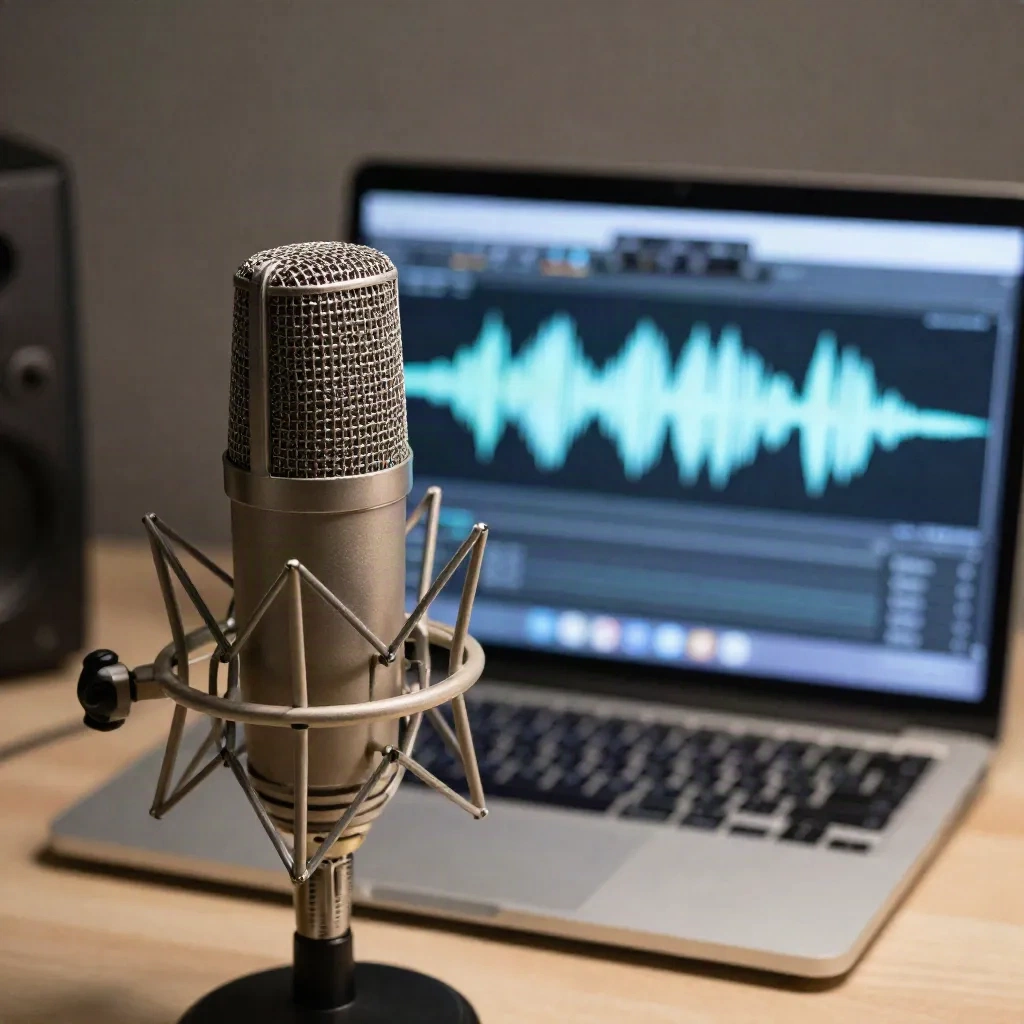
A well-configured capture chain for voice AI work typically looks like this: a decent condenser microphone (cardioid polar pattern to reject off-axis noise) with a pop filter, into a USB or hybrid audio interface, with an AI noise suppression tool inserted as a system-level virtual device, feeding into the DAW at 48kHz / 24-bit. That chain handles most home and semi-professional environments without requiring post-processing.
Once you have clean audio at 48kHz / 24-bit, you have solid source material for whichever voice AI platform your workflow requires, whether you are training a clone or generating secondary character voices at scale.
Before your next session
AI noise cancellation is not a cure for a bad recording environment. A model trained to suppress keyboard clicks will handle keyboard clicks well. It will struggle with a room that reverberates at 200-300ms and smears every consonant. Reverberation is not noise in the spectral sense; it is a convolution artifact that requires a separate class of processing called dereverberation, still an open research problem in the DNN space.
What AI noise cancellation reliably delivers is suppression of the non-speech, non-reverberant components of a signal, including the transient and non-stationary ones that have historically escaped traditional tools. If your recording environment is treated for reverberation but still picks up environmental intrusions, an on-device DNN noise suppressor inserted at capture is a practical upgrade that costs under $100 per year and reduces your post-processing time meaningfully.
Run it at capture. Record clean. Then let the voice AI tools do what they are trained to do on source material that is actually ready for them.